
The first tax filing season as an LLC owner produces a specific kind of stress that experienced business owners forget and new ones aren’t warned about. It’s not that the taxes are necessarily complicated. It’s that the rules governing how LLCs are taxed are genuinely confusing, the terminology is unfamiliar, and the consequences of getting it wrong feel significant when you’ve never done it before.
The good news is that most single-member LLCs have straightforward tax situations once the core concepts are understood. Multi-member LLCs add complexity, but that complexity follows predictable rules. Here’s how it actually works.
The First Thing to Understand: LLCs Don’t Have Their Own Federal Tax Classification
The IRS does not recognize the LLC as a distinct tax entity the way it recognizes corporations or partnerships. Instead, LLCs are taxed based on how many members they have and whether they’ve made an election to be taxed differently.
A single-member LLC is taxed as a sole proprietorship by default. The IRS treats it as a disregarded entity, meaning the LLC’s income and expenses flow directly to the owner’s personal tax return as if the business were operated as an individual rather than a separate company.
A multi-member LLC is taxed as a partnership by default. The LLC files an informational partnership return, and each member reports their share of income and losses on their personal returns.
Both single-member and multi-member LLCs can elect to be taxed as an S corporation or C corporation by filing the appropriate election forms with the IRS. Whether that election makes sense depends on the business’s profitability and the owner’s specific tax situation, and it’s a decision worth discussing with a tax professional rather than making based on generic advice.
Single-Member LLC: What You’re Filing
If you’re the sole owner of an LLC and haven’t made a corporate tax election, your LLC’s taxes are filed on your personal Form 1040 using Schedule C.
Schedule C is where business income and expenses are reported. The form calculates net profit or loss from the business, which then flows to your Form 1040 as part of your total income. You don’t file a separate business tax return. The business’s financial activity lives on your personal return.
The steps follow a clear sequence. Total all business income received during the tax year. Total all deductible business expenses by category. Subtract expenses from income to arrive at net profit or loss. Net profit flows to Form 1040 and is subject to both income tax at your ordinary rate and self-employment tax.
Self-employment tax is the element that most first-time LLC owners don’t anticipate. When you work for an employer, Social Security and Medicare taxes are split between you and your employer, each paying 7.65 percent. When you’re self-employed, you pay both halves, totaling 15.3 percent on net self-employment income up to the Social Security wage base, and 2.9 percent above it. You can deduct half of the self-employment tax paid as an adjustment to income, which reduces but doesn’t eliminate the impact.
On a net profit of $80,000, the self-employment tax alone runs approximately $11,300 before any income tax calculation. First-time business owners who budget based on income tax rates alone and ignore self-employment tax often face a significant surprise at filing.
Multi-Member LLC: Partnership Tax Filing
If your LLC has two or more members and hasn’t elected corporate taxation, it’s taxed as a partnership and must file Form 1065, the US Return of Partnership Income, by March 15 for calendar-year partnerships.
Form 1065 is an informational return rather than a tax return in the traditional sense. The partnership itself doesn’t pay federal income tax. Instead, Form 1065 reports the LLC’s total income, deductions, and credits, and allocates each member’s share through Schedule K-1.
Each member receives a Schedule K-1 showing their allocated share of the partnership’s income, losses, deductions, and credits. That K-1 information gets reported on each member’s personal Form 1040. The tax liability sits with the individual members, not the LLC.
K-1s must be issued to all members before they can complete their personal returns, which is why the partnership return deadline of March 15 falls before the individual return deadline of April 15. Delays in filing the partnership return cascade into delays for every member’s personal filing.
The allocation of income and losses among members follows the operating agreement. If three members each own one-third of the LLC, each receives one-third of the K-1 income. If the operating agreement specifies different allocations, those govern, subject to IRS rules about special allocations that have substantial economic effect.
Quarterly Estimated Taxes: The Obligation Most First-Year Owners Miss
LLC owners who expect to owe $1,000 or more in federal taxes for the year are required to make quarterly estimated tax payments rather than paying the full amount at filing. The quarterly deadlines fall on April 15, June 15, September 15, and January 15 of the following year.
Missing estimated tax payments doesn’t create a criminal liability, but it does generate underpayment penalties that accumulate throughout the year. More practically, a business owner who hasn’t made estimated payments throughout the year faces a large lump-sum payment at filing that creates cash flow stress and sometimes genuine hardship.
Calculating estimated payments in the first year is imprecise because you don’t know exactly what the full year’s profit will be. Two approaches work. The safe harbor method bases payments on last year’s tax liability, though this is only relevant if you had a prior year with income. The current-year method estimates the year’s likely profit, calculates the expected tax liability including self-employment tax, and divides by four. Either approach that results in paying at least 90 percent of the current year’s liability or 100 percent of the prior year’s liability avoids the underpayment penalty.
Deductible Business Expenses: What You Can Claim
Reducing taxable income through legitimate deductions is the most direct way to reduce the tax liability on LLC income. The IRS allows deductions for ordinary and necessary business expenses, meaning costs that are common in your industry and directly connected to running the business.
Common deductible expenses for small business LLCs include advertising and marketing costs, office rent or the home office deduction if part of the home is used exclusively for business, business insurance premiums, legal and professional fees including accounting and consulting, software and technology subscriptions, business travel and vehicle expenses, professional development and education, business meals at 50 percent of the cost, and salaries and wages if the LLC has employees.
The home office deduction deserves specific attention because it’s legitimate, frequently overlooked, and often misunderstood. If part of the home is used regularly and exclusively for business, a portion of home expenses including mortgage interest or rent, utilities, insurance, and repairs can be deducted. The simplified method allows a deduction of $5 per square foot of dedicated office space up to 300 square feet. The actual expense method requires calculating the percentage of the home used for business and applying that percentage to total home expenses, which produces a larger deduction in most cases but requires more documentation.
The Qualified Business Income Deduction
First-year LLC owners often don’t realize they may be eligible for the qualified business income (QBI) deduction, which allows eligible self-employed individuals and pass-through business owners to deduct up to 20 percent of qualified business income from their taxable income.
The deduction is subject to income thresholds and limitations that phase in above certain income levels, and certain service businesses face additional restrictions at higher income levels. Below the threshold amounts, which are adjusted annually for inflation, most LLC owners with profitable businesses can take the full 20 percent deduction. On $100,000 of qualified business income, that represents a $20,000 reduction in taxable income, which at a 22 percent tax rate saves $4,400 in federal income tax.
The QBI deduction is calculated on Form 8995 or 8995-A and flows to the personal return as a deduction from adjusted gross income rather than a business expense on Schedule C.
State Tax Obligations
Federal taxes are only part of the picture. Most states impose their own income tax obligations on LLC income, and some states have specific LLC taxes or fees that apply regardless of profitability.
California is the most notable example. California charges LLCs an $800 annual franchise tax minimum regardless of whether the LLC made any money, plus an additional fee for LLCs with income above $250,000. New York has its own LLC publication requirement and biennial filing fees. Texas imposes a franchise tax on LLCs with revenue above a threshold. Every state has different rules, and first-year LLC owners in states with specific LLC taxes sometimes miss these obligations entirely because they’re not prominently discussed in generic federal tax guidance.
Sales tax obligations add another layer for LLCs selling taxable goods or services. Sales tax is administered at the state level with varying rates and rules, and the expansion of economic nexus standards following the 2018 South Dakota v. Wayfair Supreme Court decision means that LLCs selling into other states may have tax collection and remittance obligations in those states without any physical presence there.
Record-Keeping That Makes Filing Straightforward
The quality of first-year tax filing is almost entirely determined by the quality of record-keeping throughout the year. Businesses that tracked income and expenses consistently in well-organized categories face a relatively straightforward compilation exercise at tax time. Those that reconstruct the year from bank statements and receipts face hours of work and inevitable inaccuracies.
Separating business and personal finances from the first day of operation is the foundational practice. A dedicated business bank account and business credit card create a clear record of business transactions without requiring any separation exercise at year end. Every business transaction flows through business accounts, and every personal transaction flows through personal accounts.
Accounting software that categorizes transactions in real time reduces the year-end compilation to a report export rather than a manual reconciliation. QuickBooks Online, FreshBooks, and Wave all integrate with business bank accounts and generate the income and expense summaries that Schedule C preparation requires.
When to Hire a Tax Professional
Most single-member LLCs in their first year can file their own taxes using tax software if their financial situation is straightforward. TurboTax Self-Employed, H&R Block Self-Employed, and TaxAct Self-Employed all guide filers through Schedule C preparation with reasonable accuracy for uncomplicated situations.
The cases where professional help is clearly worth the cost include multi-member LLCs requiring a partnership return, LLCs with employees and payroll tax obligations, businesses with significant asset purchases requiring depreciation calculations, LLCs with S corporation elections, and any situation involving significant income where the QBI deduction optimization and tax planning advice from a professional is likely to save more than it costs.
The IRS Small Business and Self-Employed Tax Center is the most authoritative free resource for LLC tax filing guidance, providing direct access to the forms, instructions, and publications that govern every aspect of small business tax compliance without any commercial interest in steering you toward particular products or services.
The Year-End Checklist
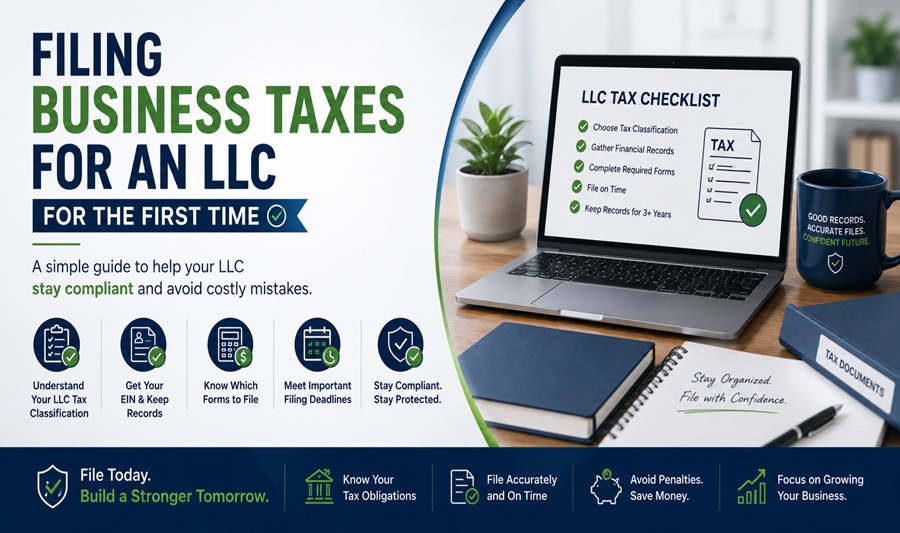
Before filing, a complete first-year LLC tax preparation covers the following ground. Confirm the LLC’s default tax classification and whether any elections were made. Gather all income records and reconcile against bank deposits. Compile all expense records organized by category with supporting documentation. Calculate home office square footage and expenses if applicable. Confirm whether quarterly estimated payments were made and in what amounts. Identify any asset purchases that may qualify for Section 179 expensing or bonus depreciation. Review whether the QBI deduction applies and calculate the eligible amount. Confirm state filing obligations and deadlines in every state where the business has nexus.
That checklist isn’t exhaustive for every situation, but it covers the ground that first-year LLC owners most commonly miss or handle incorrectly. Getting through it methodically produces a filing that accurately reflects the business’s first year without leaving legitimate deductions on the table or creating compliance gaps that create problems later.
